
A Diminished Inheritance
A field guide to what was passed down and what we’re still healing.

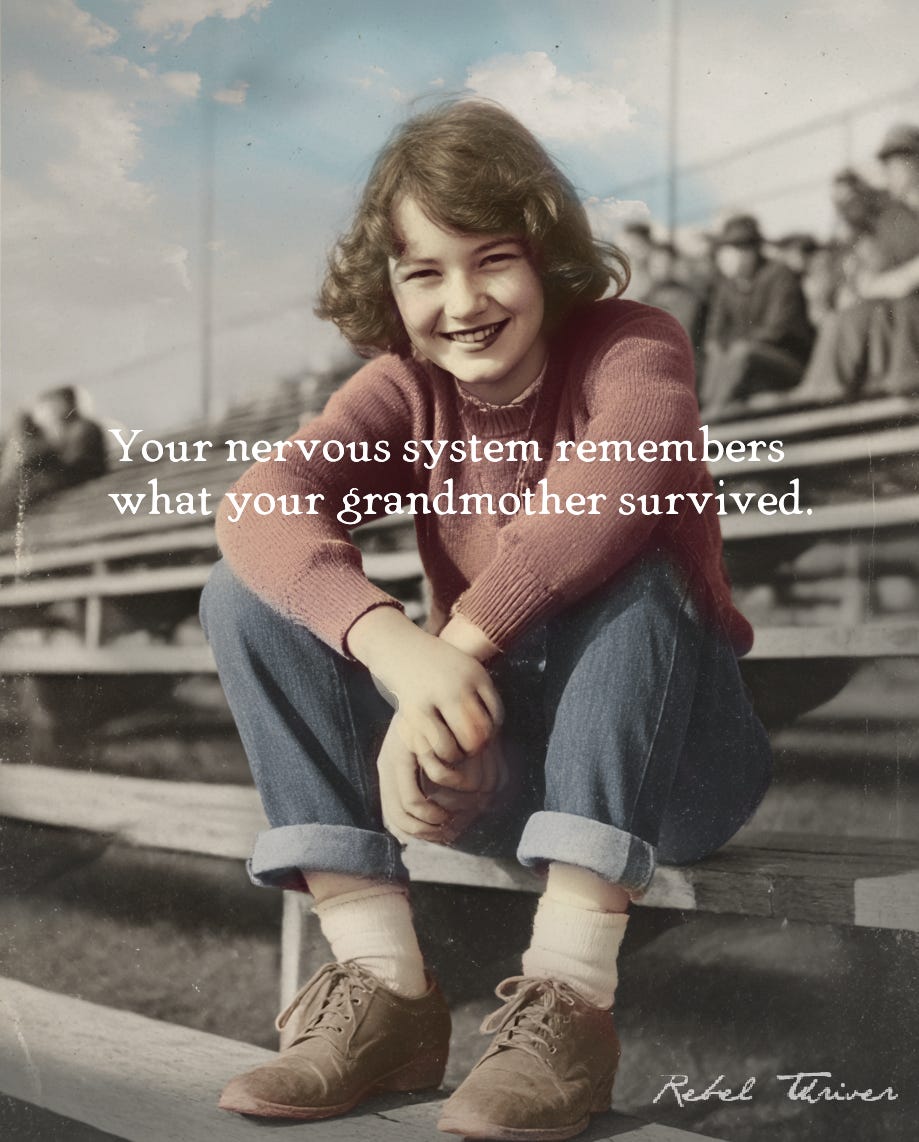
My grandmother was a rebel. As a teenager in the 1920s, she was the first woman in her community to wear jeans in public (she stole them from her brother). That was not a small thing then. That was a statement, a provocation, a declaration of something about who she intended to be. She kept that fire her entire life. She pushed boundaries, spoke her mind, refused to shrink. She lived to be 104 years old. I adored her. She was a second mother to me, and losing her six years ago left a particular kind of absence that I am still learning to carry.
But I also watched what happened to her when my grandfather entered the room. Her wings clipped, visibly and reliably, every time. The same woman who had challenged social norms in her youth would make herself noticeably smaller in the presence of the man she loved. She didn’t disappear. But she dimmed. And I watched it happen so many times that I stopped seeing it, the way you stop seeing the furniture in a room you’ve lived in your whole life.
That image — a bold woman, a fabulous woman, choosing smallness inside the one relationship that demanded it — is the truest picture I have of what this essay is actually about.
I have been sitting with a question for years. Long before I had language for it, I felt the wrongness of where women’s healing work so often lands, right in the lap of the woman who came before us, as if she were the origin of the damage rather than one of its casualties. Why do we blame our mothers when they themselves were confined and stripped of their autonomy?
I know this because I lived it. My mother grew up in the 1950s, the prom queen, the parties, the storybook adolescence of someone who had been given, at least for a season, the full costume of girlhood freedom. She met my father at fifteen. She carried those years like a promise of what life could be, and she passed that promise to me.
And then she helped lock the door.
I was furious that the teenage years she had promised me, based on her own lived experience, were ultimately denied to me. At sixteen I was forbidden to date. She had set me up to dream, and then she participated in shutting the dream down. She lied to me. I don’t think she knew she was lying. I think she believed it, right up until the moment the rules changed and she enforced them. That broke something in me. I rebelled hard, as girls who are caged tend to do. And then, like my grandmother and my mother before me, I ended up with my wings clipped.
When I was a teenager watching my mother submit to my father, quietly, consistently, in the way that evangelical Christianity had taught her was virtue, I hated her for it. I swore I would never be that woman. I thought she was weak, because I thought she was choosing it.
What she was actually doing was teaching me. She and my grandmother both were. They were teaching me how to survive inside an oppressive dynamic. How to make yourself small. How to swallow your opinion before it reached your throat. How to read the temperature of a room and go quiet when your partner was close to anger. They had learned it from the women before them. It was the most important survival knowledge they possessed, and they passed it to me the only way they knew how: by example.
I rejected it. I was furious at them for it. And then I walked straight into a marriage that made everything they had tried to prepare me for look mild by comparison. In my marriage, speaking out wasn’t just difficult, at times it carried life or death consequences. The very tools my mother and grandmother had tried to hand me, the careful silence and the strategic smallness, were the tools I had thrown back in their faces. And then I needed those same tools to keep myself alive.
I am not telling you this to be dramatic. I am telling you this because it is the clearest illustration I have of how this wound actually works. My mother wasn’t failing me. She was doing what women have done for centuries: passing down the knowledge of how to survive in a world built to contain them. The tragedy isn’t that she taught me those things. The tragedy is that she had to.
The mother wound conversation, as it circulates in wellness spaces, can quietly do the patriarchy’s work for it by keeping women focused on each other as the source of harm rather than the system that shaped every choice their mothers made.
A woman who was cold, or who didn’t protect her daughter, or who stayed, was usually also a woman who had been stripped down to survival. She was passing on what she had been given, which was itself a diminished inheritance. Blaming her without that context is just another way of keeping the real architecture invisible.
That’s not a small distinction. That’s the whole damned thing.
So let’s name the architecture.
Underneath every system that has ever organized itself around the control of women, every theology, every legal code, every social structure that has told women to be quiet, to be small, to be grateful for protection in exchange for obedience, there is fear. Not strength. Fear. The fear of losing control, and through it, power. Power is an intoxicant unlike almost anything else, and history is a long record of what people will do to keep it. What institutions will construct. What stories they will tell. What they will bury.
Frightened people with institutional power are the most dangerous kind. They build systems to protect that fear, and then call it order. They decide which books make it into the canon and what is taught in the classroom. They decide whose history is worth recording and whose gets swallowed by time. And they are very good at making their fear look like morality, like the natural way of things.
I want to be precise here, because the word patriarchy shuts people down more than it opens anything. I’m not talking about men as a category. I’m talking about what fear builds when it has enough power to organize itself. Men suffer inside that machinery too. But women have historically borne the weight of it in ways that are particular and compounding, and we are only now beginning to understand the full biological cost of that.
Because here is what we know now that our grandmothers didn’t have words for: the body keeps score across generations. Epigenetics is the study of how lived experience alters gene expression and passes those alterations to our children and grandchildren. It has given us a scientific language for what women have always carried in their bones. The anxiety that arrives before you can name a reason. The hypervigilance. The way your body responds to a raised voice before your mind has even registered the threat. These are not weaknesses or character flaws. They are inherited survival adaptations, written into you by women who needed them desperately and had no way to lay them down.
Your nervous system remembers what your grandmothers survived. Your body is carrying her adaptations alongside your own. That is not metaphor. That is physiology.
And it isn’t only fear and silence that get passed down. Beauty, instinct, courage, and an audacious kind of hope move through the lineage too. The dreams she couldn’t live don’t disappear. They move forward, looking for someone with enough room to carry them.
And it goes back further than our grandmothers.
Women have always found ways to speak, even when speaking was forbidden. Wherever they were permitted to gather, they built something there. The quilting circle was not just a practical gathering, it moved information, shared grief, and kept knowledge alive in ways the public world couldn’t touch. The same was true of the knitting circle, the kitchen, the lying-in room where women attended births without men present. They coded their resistance into domestic craft. They kept knowledge alive in whisper circles when it wasn’t safe to speak it plainly.
The women who were healers, midwives, herbalists, teachers, spiritual leaders didn’t disappear because their knowledge became irrelevant. They were co-opted by the church, sanitized, and then sainted. They were pushed out, discredited, and in too many cases, killed for it.The dismantling was systematic and intentional. You don’t spend centuries legally prohibiting women from owning property, practicing medicine, accessing education, or speaking in public assembly because you believe they have nothing to offer. You do it because you know they do.
That knowledge didn’t vanish. It went underground. It moved through the quilting circles and the kitchen gatherings and the whispered instructions passed from mother to daughter in the dark. It survived in fragments, in folk traditions, in the stubborn persistence of women who kept tending the things that mattered even when the world told them those things had no value.
We are the descendants of those women. And we are living inside the compounded weight of what was taken from them, taken from us through them, over a very long time.
I work with women to help them understand this. Not just in the abstract, but in the body. In the specific, inherited, physiological reality of what it means to carry generations of silencing in your nervous system. The anger, the grief, and the longing you feel toward your mother for what she couldn’t give you is real, and it deserves space. And it is vital that you understand she was not the source. She was a woman trying to survive inside a world arranged against her, doing her best with a diminished inheritance, passing on what she had.
Holding both of those truths at once is not easy. But it is where real forgiveness lives, not the performance of it, not the suppression of legitimate anger, but the kind that comes when you finally see the full context of someone’s life.
When women stop locating the wound in each other and start seeing the machinery that shaped all of us, something opens. The work stops being about fixing what is broken and starts being about recovering what was taken. Those are not the same project. One keeps you focused on your own damage. The other connects you to every woman who came before you and couldn’t finish what you are now finishing.
My grandmother wore jeans in public in the 1920s and lived a century of stubborn, beautiful aliveness. She also dimmed herself in the presence of the man she loved, every single time, without fail, until the day he died. Both of those things were true. She was not broken by the second one. But she was shaped by it, and so was my mother, and so was I, and so are you.
The wound was never hers to carry. And it was never yours either.
We are just the generation that finally gets to put it down.
꩜ Ella
Powerful. Personal. Relatable. Thank you for sharing your heart and soul to remind us of what we carry. xo
Deep bow. I'm 60 and I've spent a lifetime confused by my relationships with my mom and my older sisters. I've pondered the lives of my aunts and my grandmothers and imagined how and why I'm carrying a mix of love and pain. Your words are profound and helpful. I'm so very ready to put down the pain and blame, integrate the lesson and move forward in love and a version of power that serves me and my remaining sister and my nieces and the next generation of women. Thank you.